
Food Safety Guide
At Mercy Chefs, food safety is more than a requirement—it’s a responsibility we share with our partners to protect the health and well-being of every person receiving our meals. Proper handling, storage, and transportation of food ensures that meals remain safe, nutritious, and high-quality from the kitchen to the table. We hope this resource provides clear guidelines for time and temperature control, serving practices, utensil use, and transporting food to remote sites. By following these procedures, you help prevent foodborne illness and uphold the highest standards of care for the communities we serve.
Hot & Cold Holding
for TCS Foods
PURPOSE: Prevent foodborne illness by ensuring all Time/Temperature Control for Safety (TSC) foods are held at the proper temperature.
SCOPE: This applies to school nutrition employees preparing, holding, or serving food.
INSTRUCTIONS
- Train school nutrition employees on using this procedure in this SOP. (Please refer to the Using and Calibrating Thermometers SOP.)
- Follow all state or local health department requirements.
- If based on the FDA Food Code:
- Hold hot foods at 135 ºF or above.
- Hold cold foods at 41 ºF or below.
- Preheat steam tables and hot boxes.
MONITORING
- Use a clean, sanitized, and calibrated probe thermometer to measure the temperature of the food.
- Take temperatures of food by inserting the thermometer near the surface of the product, at the thickest part, and at other various locations.
- Take temperatures of holding units by placing a calibrated thermometer in the coolest part of a hot holding unit or the warmest part of a cold holding unit.
- For hot food held for service:
- Verify that the air/water temperature of any unit is at 135 ºF or above before use.
- Reheat foods in accordance with the Reheating for Hot Holding SOP.
- All hot TCS foods should be 135 ºF or above before placing the food out for display or service.
- Take the internal temperature of food before placing it on a steam table or in a hot holding unit, and at least every two hours thereafter.
- For cold food held for service:
- Verify that the air/water temperature of any unit is at 41 ºF or below before use.
- Chill foods in accordance with the Cooling TCS Foods SOP.
- All cold time/temperature control for safety foods should be 41 ºF or below before placing the food out for display or service.
- Take the internal temperature of the food before placing it onto any salad bar, display cooler, or cold serving line, and at least every two hours thereafter.
CORRECTIVE ACTION
- Retrain any employee not following the procedures in this SOP.
- For hot foods:
- Reheat to 165 ºF for 15 seconds if the temperature falls below 135 ºF and if the last temperature measurement was 135 ºF or higher within the last two hours.
- Repair or reset holding equipment before returning food to unit.
- Discard food if the time below 135 ºF is unknown.
- For cold foods:
- Rapidly chill food using an appropriate cooling method if temperature rises above 41 ºF and if the last temperature measurement was 41 ºF or below within the last two hours.
- Place food in shallow containers (no more than two inches deep) and uncovered on the top shelf in the back of the walk-in or reach-in cooler.
- Use a quick-chill unit like a blast chiller.
- Stir the food in a container placed in an ice water bath.
- Add ice as an ingredient.
- Separate food into smaller or thinner portions.
- Repair or reset holding equipment before returning food to unit.
- Discard food if the time above 41 ºF is unknown.
- Rapidly chill food using an appropriate cooling method if temperature rises above 41 ºF and if the last temperature measurement was 41 ºF or below within the last two hours.
WITHOUT TCS FOODS
- Hot food should be labeled when removed from hot holding with a discard time of four hours from removal at 135 degrees.
- Cold food should be labeled when removed from cold holding with a discard time of six hours from removal at 41 degrees. Cold food should not exceed 70 degrees during this time.
VERIFICATION & RECORD KEEPING
- Record food temperatures and document corrective actions taken on the Production Record.
- Verify your team has taken the required holding temperatures by visually monitoring personnel during the shift and reviewing the temperature logs at the close of each day.
- Keep temperature logs on file for a minimum of one year.
Serving Food
PURPOSE: Prevent foodborne illness by ensuring that all food is served in a sanitary manner.
SCOPE: This applies to school nutrition employees serving food.
INSTRUCTIONS
- Train partners on using the procedures in this SOP.
- Follow all state or local health department requirements and the employee health policy. (Please note: Employee health policy is not included in this resource.)
- Wash hands before putting on gloves, when changing gloves and tasks, and before serving food with utensils. (Please refer to the Washing Hands SOP.)
- Avoid touching ready-to-eat foods with bare hands. (Please refer to the Using Suitable Utensils When Handling Ready-to-Eat Foods SOP.)
- Handle plates by the edge or bottom; cups by the handle or bottom; and utensils by the handles.
- Store utensils with handles up or by other means to prevent contamination.
- Maintain TCS foods at the proper temperature. (Please refer to the Hot and Cold Holding for TCS Foods.)
- Serve food with clean and sanitized utensils.
- Properly store in-use utensils.
- Date-mark and cool TCS foods, or discard leftovers. (Please refer to the Date Marking Ready-to-Eat SOP and Cooling TCS Foods SOP.)
MONITORING
A designated employee visually observes that food is being served in a manner that prevents contamination during all hours of service.
CORRECTIVE ACTION
- Retrain any partner or employee not following the procedures in this SOP.
- Replace improperly handled plates, cups, or utensils.
- Discard ready-to-eat food touched with bare hands.
- Follow the corrective actions identified in the listed SOPs above.
VERIFICATION & RECORD KEEPING
- Periodically check the storage and use of utensils during service.
- Manager completes the Food Safety Checklist daily.
- Keep the Food Safety Checklist on file for a minimum of one year.

Using Suitable Utensils
for Ready-to-Eat Foods
PURPOSE: Prevent foodborne illness due to hand-to-food cross-contamination.
SCOPE: This applies to any partner or employee preparing, handling, or serving food.
INSTRUCTIONS
- Train partners and employees on using the procedures in this SOP.
- Follow all state or local health department requirements.
- Wash hands and exposed arms prior to preparing and handling food or whenever hands may have become contaminated.
- Do not use bare hands to handle ready-to-eat foods at any time, except when washing fruits and vegetables.
- Use suitable utensils, including:
- Single-use gloves
- Deli tissue
- Foil wrap
- Tongs, spoodles, spoons, and spatulas
- Wash hands and change gloves:
- Before food preparation or starting a new task.
- After touching equipment (e.g., refrigerator doors or utensils that have not been cleaned and sanitized), chemicals, or money.
- When interruptions in food preparation occur (e.g., answering the telephone or checking in a delivery).
- Anytime a glove is torn, damaged, soiled/contaminated.
- Between handling raw meat and ready-to-eat food.
MONITORING
A designated employee visually observes that gloves or suitable utensils are used and changed at the appropriate times during all hours of operation.
CORRECTIVE ACTION
- Retrain any employees not following the procedures in this SOP.
- Discard ready-to-eat food touched with bare hands.
VERIFICATION & RECORD KEEPING
- Verify that employees are using suitable utensils by visually monitoring them during all hours of operation.
- Complete the Food Safety Checklist daily.
- Keep the Food Safety Checklist and Production Records on file for a minimum of one year.
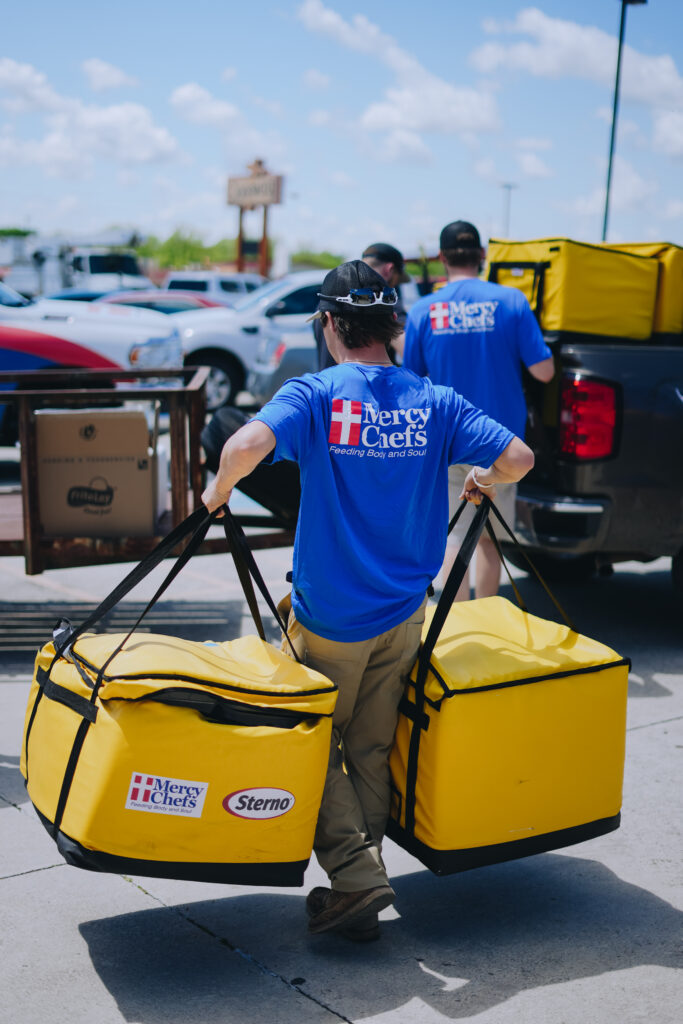
Transporting Food to Remote Sites
Satellite Kitchens
PURPOSE: Prevent foodborne illness by maintaining food temperatures during transportation and preventing contamination.
SCOPE: This applies to partners who transport food from a central kitchen to remote sites (satellite kitchens).
INSTRUCTIONS
- Train school nutrition employees on using the procedures in this SOP.
- Follow all state or local health department requirements.
- If based on the FDA Food Code:
- Keep frozen foods frozen during transportation.
- Maintain cold TCS food at 41 ºF or below and hot food at 135 ºF or above.
- Use National Sanitation Foundation (NSF) International-approved or state/local health department-approved food carriers.
- Prepare the food carriers before use:
- Ensure all surfaces are clean by washing, rinsing, and sanitizing.
- Ensure carriers are designed to maintain cold food temperatures at 41 ºF and hot food temperatures at 135 ºF or above.
- Place a calibrated stem thermometer in the warmest part of a carrier if transporting cold food, or the coolest part if transporting hot food. (Please refer to the Using and Calibrating Thermometers SOP.)
- Pre-heat or pre-chill carriers according to the manufacturer’s recommendations.
- Store food in containers suitable for transportation. Containers should be:
- Rigid and sectioned so food doesn’t mix.
- Tightly closed to retain the proper food temperature.
- Non-porous to avoid leakage.
- Easy-to-clean or disposable.
- Approved to hold food.
- Place containers inside food carriers and transport in clean trucks, if applicable, to remote sites as quickly as possible.
- Follow the Receiving Deliveries SOP upon arrival at remote sites.
MONITORING
- Check the carrier’s air temperature to ensure that the temperature suggested by the manufacturer is reached before loading food.
- Check internal food temperatures using a calibrated thermometer before placing food in carriers. (Please refer to the Hot and Cold Holding for TCS Foods SOP for the proper procedures on holding temperatures.)
CORRECTIVE ACTION
- Retrain any employees not following the procedures in this SOP.
- Continue heating or chilling carrier if the proper air temperature is not reached.
- Reheat food to 165 ºF for 15 seconds if the internal temperature is less than 135 ºF. (Please refer to the Reheating TCS Foods SOP.)
- Chill food to 41 ºF or below using a proper cooling procedure if the internal temperature is greater than 41 ºF. (Please refer to the Cooling TCS Foods SOP.)
- Discard food held in the danger zone for more than four hours.
VERIFICATION & RECORD KEEPING
- Before transporting food to remote sites, record carrier temperatures, internal temperatures, food product name, time, and any corrective action taken on the Production Record.
- Upon receipt of food at remote sites, record receiving temperatures and corrective action taken on the Receiving Log.
- The central kitchen partner verifies that this SOP is being followed by visually observing employees and reviewing and initialing the Hot and Cold Holding Temperature Log daily.
- The remote site partner verifies that they are receiving food at the proper temperatures and visually observes receiving practices during the shift, and reviews and initializes the Receiving Log daily.
- Complete the Food Safety Checklist daily.
- Keep all logs, including the Food Safety Checklist, on file for a minimum of one year.